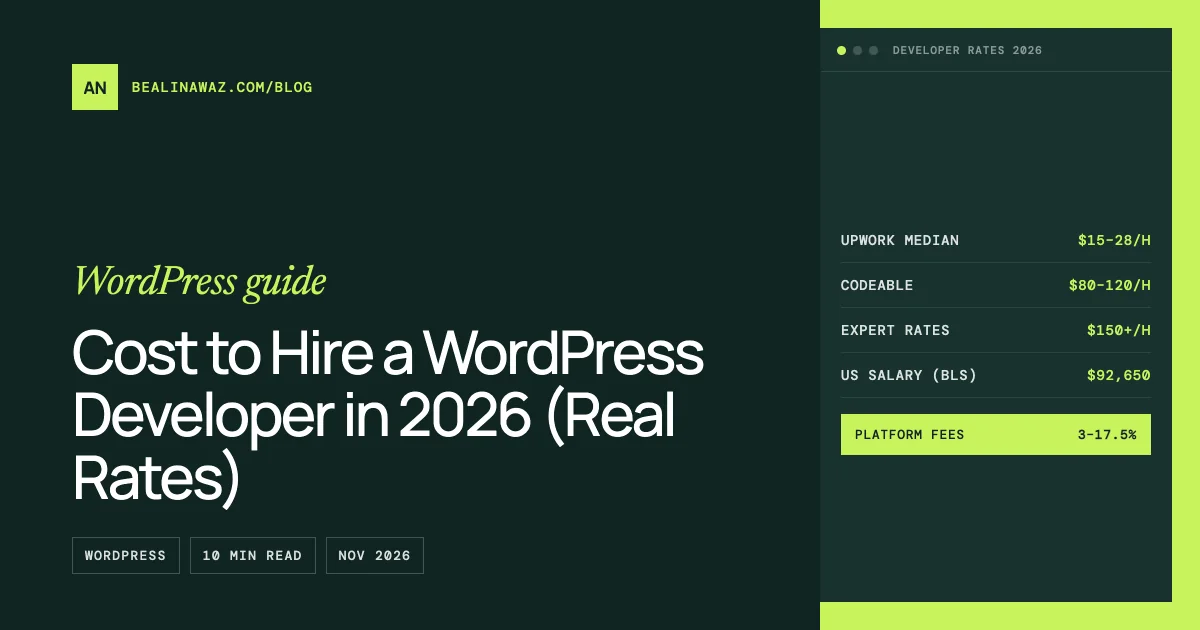
The cost to hire a WordPress developer in 2026 runs from about $15 an hour on freelance marketplaces to $150 or more an hour for senior specialists. A WooCommerce plugin conflict test costs $150 on Codeable. Custom plugins, themes and business websites start in the high hundreds and climb into the thousands. The rate matters less than how the work is priced, what the platform adds in fees, and what the site keeps costing after launch.
Below are the published numbers from the places people actually hire, checked on each source's own pages on November 1, 2026. I also explain how I price my own work, as a freelance WordPress developer who has built sites, themes and plugins since 2017.
Short answer: WordPress developer rates in 2026
| Where you hire | What they publish | Fees on top |
|---|---|---|
| Upwork | Median $15 to $28 an hour on its WordPress cost page; it also says experts may charge $150 or more an hour | 5% marketplace fee on the Basic plan, plus a one-time contract fee of $0.99 to $14.99 |
| Fiverr | Fixed-price gigs set by each seller | 5.5% service fee, plus $3.50 on orders under $200 |
| Codeable | Estimates based on $80 to $120 an hour | 17.5% service fee |
| Toptal | No public rates | Pricing given after a call; a no-risk trial |
| In-house employee (US) | Median $92,650 a year for web developers (BLS, May 2025) | Benefits, tax, equipment, management |
Marketplace medians and employee salaries don't measure the same thing. A median on a global marketplace mixes beginners and experts from every country. A US salary includes no platform fee but carries a full year of cost whether or not there is work.
What the official numbers say
US salaries: the BLS benchmark
The US Bureau of Labor Statistics is the most reliable source for what developers earn as employees. Its Occupational Outlook Handbook puts the median pay for web developers and digital designers at $99,520 a year, or $47.85 an hour, in May 2025. For web developers alone, the median is $92,650. BLS expects employment in the group to grow 5% from 2025 to 2035, faster than the average for all jobs.
The detailed OEWS figures for web developers show the spread: a median of $44.54 an hour and a mean of $47.49, with the lowest 10% earning under $23.12 an hour and the top 10% over $78.03. These are wages, not freelance rates. A freelancer or agency charging a business has to cover gaps between projects, software, tax and sales time, so client-facing rates sit above employee wages for the same skill.
Upwork: the marketplace median
Upwork's WordPress developer cost page shows median hourly rates of $15 to $28. Its footnote says the figures come from historical contracts worldwide, which is why they're low: they include every level of experience in every country. The page's own text describes a range of $15 to $40 and up, and Upwork's hiring page adds that experts may charge $150 or more an hour.
Clients pay a fee on top. On Upwork's client pricing page, the Basic plan charges a 5% marketplace fee (3% for eligible US clients paying from a checking account) and a one-time contract initiation fee of $0.99 to $14.99. The Business Plus plan charges 10%.
Fiverr: fixed-price gigs
On Fiverr, each seller sets a package price, so there's no single rate to quote. What Fiverr does publish is its own fee. Its payment terms list a 5.5% service fee on each gig purchase, plus a $3.50 small-order fee on gig orders under $200. A $50 fix therefore costs $56.25 at checkout.
Codeable: vetted WordPress experts
Codeable only lists WordPress specialists. Its pricing page says a project gets a single estimate based on an hourly rate of $80 to $120, plus a fixed 17.5% service fee. It also publishes starting prices: $420 for speed and security work, $960 for a custom plugin, $980 for a custom theme, $2,500 for a website and $3,200 for an online store. For WooCommerce, Codeable sells a conflict test at $150 for about 90 minutes, covering up to 10 plugins and the theme.
Toptal: pre-screened, priced on request
Toptal's WordPress developer page doesn't publish rates. It says it accepts the top 3% of applicants, offers a no-risk trial where you pay only if satisfied, and matches clients with a developer in under 24 hours on average. You get a price after a call about your project.
What a WordPress project costs, by type
Hourly rates only matter once you know the size of the job. These are the main kinds of WordPress work and what drives the price of each.
| Work | What changes the price |
|---|---|
| A fix: plugin conflict, error, broken checkout | How quickly the cause can be reproduced, and whether the fix needs custom code |
| Speed and security work | Hosting, how many plugins load on every page, image weight, and what's already been tried |
| A custom plugin | Number of features, integrations with outside systems, admin screens, and testing |
| A custom theme | Number of templates, how editable the layouts must be, and whether a design already exists |
| A business website | Page count, content readiness, forms and integrations, languages |
| A WooCommerce store | Product count and variations, payment and shipping rules, subscriptions or B2B pricing, data to import |
Codeable's starting prices are a useful reference point for the middle of the market: $420 for speed and security, about $1,000 for a custom plugin or theme, and $2,500 to $3,200 for full sites and stores. Codeable adds its 17.5% service fee to each estimate. Agencies generally quote above that. Marketplace freelancers can quote well below it, with a much wider spread in quality.
Hourly or fixed price?
Hourly suits work you can't scope yet: an unknown bug, an audit, ongoing small changes. You pay for the time used, but the total isn't known in advance, so ask for a cap.
Fixed price suits work with a clear brief: a site, a plugin, a migration, a defined fix. You know the total before work starts. The developer carries the risk of running over, so a good fixed quote comes with a written scope, and anything outside it gets quoted separately.
In practice, most WordPress jobs can be fixed-price once someone has looked at the site and the requirements. That first look should be quick and, ideally, free.
Freelancer, agency or marketplace?
- A freelancer you hire directly gives you one person who does the work and answers the email. There's no platform fee. The risk is that one person is unavailable, so ask about response time and what happens if they're ill.
- An agency adds project management, design and a team who can cover each other. You pay for that layer, and the developer doing the work may be a junior or a subcontractor.
- A marketplace handles payment protection and lets you compare many profiles quickly. You pay the platform fee, and you'll spend time filtering through proposals.
None of them is right for every job. A broken checkout needs someone fast and specific. A full rebrand with copy, design and photography may need an agency. A one-off plugin can go well with any of the three if the brief is clear.
The costs after launch
The developer is often the smallest long-term cost. Budget for these too:
- Hosting: varies widely by traffic and whether it's a store.
- Premium plugins: for example, Elementor's paid plans list at $60 a year for Essential, $84 for Advanced Solo and $108 for Advanced across three sites (elementor.com). WooCommerce itself is free, but WooCommerce Subscriptions is $279 a year and Product Bundles $79 a year on woocommerce.com.
- Maintenance: updates, backups and checking that nothing broke. Plugins and WordPress itself release updates all year, and someone has to test them.
- Changes: new pages, new campaigns, new features as the business grows.
A cheap build that needs a developer for every small edit can cost more over two years than a pricier one your team can edit alone.
How to keep the cost down without getting a bad site
- Write down what the site must do, not how it should look. Five bullet points on goals and must-have features save hours of back and forth.
- Have your content ready. Waiting for copy and images is the most common reason projects slip.
- Ask for a fixed quote with a written scope, and for anything outside it to be quoted before it's done.
- Pay in stages. Paying part at the start and the rest on delivery protects both sides.
- Ask who owns the code and the accounts. Hosting, domain and licences should be in your name.
- Check real work. Public plugins, live sites and code you can read are better evidence than a portfolio of screenshots.
How I price my own WordPress work
I don't publish a price list, because no two clients bring the same problem. A WooCommerce store with 30 products and one with 3,000 products, a B2B price list and an ERP connection are different jobs. Instead, you send me your requirements, I review them, and you get a fixed quote in US dollars before any work starts. Looking at your requirements and quoting is free.
What I can tell you up front:
- Projects start at $500. Fixes, such as a plugin conflict or a broken checkout, start at $100.
- My prices are set at about half of what agencies typically charge for the same scope. I'm one developer without an agency's overheads, and I'd rather win clients on price and quality than on sales calls.
- Payment is 50% to start and 50% on delivery, after you've reviewed the work on a staging site.
- Every project includes 15 days of free support after launch. After that, maintenance is billed monthly or per task.
- I reply within 24 hours.
I've built WordPress sites, themes and plugins full time since 2017, and 14 of my plugins are open source, so you can read my code before you hire me.
Frequently asked questions
How much does it cost to hire a WordPress developer in 2026?
Published rates run from a $15 to $28 hourly median on Upwork to $80 to $120 an hour on Codeable, with senior specialists at $150 or more. Codeable's starting prices run from $420 for speed and security work to $3,200 for an online store. Platform fees of 3% to 17.5%, plus small fixed fees on some platforms, come on top on marketplaces.
How much does a WordPress developer earn as an employee?
The US Bureau of Labor Statistics reports a median of $92,650 a year for web developers in May 2025, or $44.54 an hour. Freelance and agency rates are higher than employee wages, because they also cover tax, tools and time between projects.
Why are some WordPress developers so cheap?
Marketplace medians include every experience level in every country, which pulls the average down. A low rate can be fine for a simple, well-defined job. For checkout, security or custom code, judge the developer by work you can check, not by the rate alone.
Is it cheaper to hire a freelancer or an agency?
A freelancer you hire directly is usually cheaper, because you don't pay for an agency's project management and sales, or a marketplace fee. An agency can be the better choice when you also need design, copywriting and a team to cover holidays.
How much does it cost to fix a WordPress plugin conflict?
Codeable sells a WooCommerce conflict test for $150, covering about 90 minutes. My own plugin conflict fixes start at $100, with a fixed quote after a free look at the problem.
Should I pay a WordPress developer hourly or a fixed price?
Fixed price for anything you can describe clearly, such as a site, plugin or migration. Hourly, with an agreed cap, for unknown bugs and open-ended work.
Get a quote
If you have a WordPress project or a broken site, send me what you need. I'll review it and reply within 24 hours with questions or a fixed quote. You can see what I build on my WordPress development page, read about custom plugin development, or browse my open-source WordPress plugins.