Interactive SaaS interfaces
Front ends for SaaS products and web apps, with sign-in, settings, billing screens and the main workflow your users pay for.
Engineering service / Ali Nawaz
I build React applications for businesses that need more than a website: dashboards, customer portals, booking and quoting tools, internal admin screens and SaaS front ends. You work with one developer from the first call to launch. I write the components, wire them to your API or build that API too, test the result on real phones and browsers, and hand over a codebase another developer can pick up.
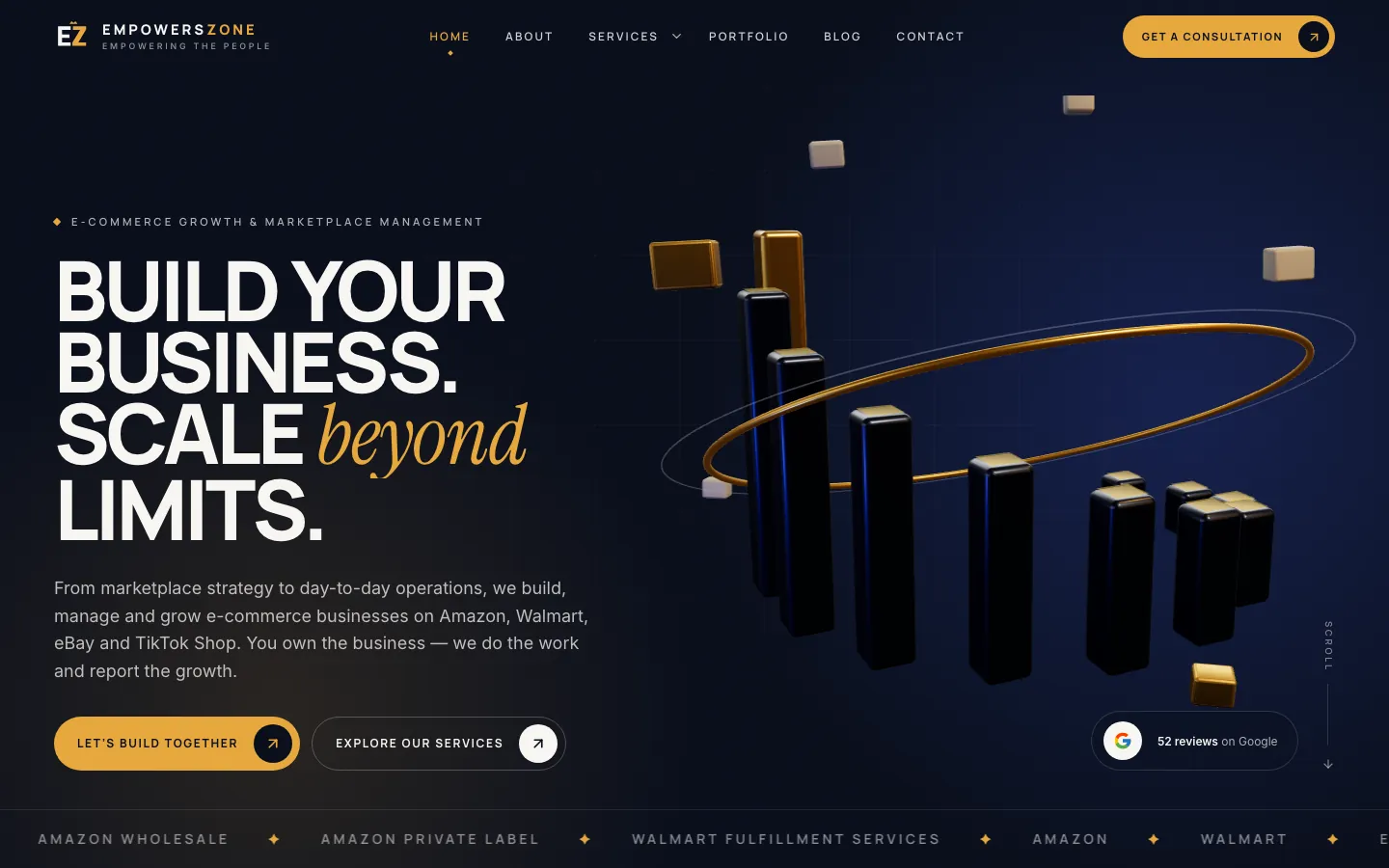 Enlarge screenshot: Agency homepage with 3D hero


Recent project
Empowers Zone
React website rebuild
Amazon service page. One of the prerendered service pages, written for one clear purpose: Amazon account management.
Read the case studyThe approach
Most React projects that go wrong don't fail on the library. They fail on unclear screens, missing states and an API that doesn't match what the interface needs. So before I quote, I list every screen, who can see it, and what it shows while loading, when it's empty and when something breaks. That list becomes the scope, and it's the reason my fixed quotes hold.
You work directly with me from requirements through launch. That keeps product context close to technical decisions and avoids the gaps that appear when strategy, interface, backend, and deployment are treated as separate problems.
What I can build
The scope is shaped around your users, operating reality, and the smallest responsible path to value.
Front ends for SaaS products and web apps, with sign-in, settings, billing screens and the main workflow your users pay for.
Dashboards that load quickly with real data, with filters, tables and charts that stay readable on a laptop and a phone.
Portals where customers, members or staff log in to see their own orders, files, bookings or reports, with permissions checked on the server.
A small set of shared components and design rules, so new screens look consistent and take less time to build.
Scope
These are the parts I plan and price in every React build. Seeing them listed helps you compare quotes, because a cheap quote often leaves several of them out.
| Part of the project | What you get |
|---|---|
| Screen list and states | Every screen and who can see it, written down with its loading, empty, error and no-permission states before any code |
| Components | React components built from your design or a simple design system I set up, reused across screens instead of copied |
| Data and API | Requests to your API with caching, retries and clear error messages, or a Node.js API built alongside it |
| Forms | Validation that matches the server's rules, keyboard-friendly inputs and messages that tell people what to fix |
| Accessibility | Semantic HTML, focus handling for dialogs and menus, color contrast checks and testing with a keyboard |
| Testing and staging | Tests for the logic that matters most and a staging link where you review every feature before launch |
New build or existing app
A new React app starts with the screen list and the data each screen needs. I agree that list with you, set up the project with TypeScript and Vite (or Next.js if public pages need to rank), and build in the order that lets you click through real screens early. You review on a staging link as features land, not only at the end.
An existing app starts with an audit. I run the code, check the build, the dependencies, how state and data fetching are handled, and where bugs keep coming from. You get a short written report and a fixed quote for the first piece of work. Many projects need targeted repairs, not a rewrite, and I'll say so when that's the case.
Cost drivers
The biggest driver is the number of screens and the rules behind them. A dashboard with five views and one user role is a much smaller job than a portal with three roles, each seeing different data. Other drivers: whether the API exists or must be built, how many third-party services are involved (payments, maps, email, CRMs) and whether you have a finished design or need me to set one up.
If the budget is tight, I'll suggest a first release with the screens that earn money or save time, and leave the rest for a second phase. A small launch you can use beats a big one that runs late.
Freelancer or agency
Agencies often sell React developers by the month. With me, you get one experienced developer who has worked since 2017, holds a BS in Software Engineering, and talks to you directly.
The trade-off is capacity. One developer can't put five people on your app next week. If you need several developers at once, choose an agency, and I'll tell you so before you pay anything.
What the work should create
Pricing
How pricing works
Client feedback
Reviews from clients I have worked with remotely, quoted as they wrote them.
The process
You get a senior engineering partner—not a black box. The process stays direct, collaborative, and focused on outcomes.
Clarify the problem, users, constraints, and measure of success.
Shape the right product, technical plan, and delivery path.
Create in focused iterations with quality visible at every step.
Test, deploy, measure, and improve with confidence.
Common questions
I don't use a price list: after reading your requirements you get a single fixed price in US dollars. As a policy, I price my work at roughly half of what agencies charge. Half is due when we start, and the rest at final delivery, once you've signed off on staging.
Yes. I start by reading the code and running it locally, then tell you in writing what's healthy, what's risky and what I'd change first. After that I ship features and fix problems in small steps, without stopping the product for a rewrite.
When public pages must rank in search or load with full HTML on the first request, Next.js is usually the better choice. For a dashboard or tool behind a login, plain React with Vite is simpler to build, host and maintain. The quote names the one I'd use and the reason.
Yes. I build Node.js and Express APIs with MySQL, PostgreSQL or MongoDB, so the front end and the API are designed together. If you already have a backend, I work against its existing endpoints and tell you early if one is missing.
Yes. The code lives in a Git repository in your account, hosting is in your name, and everything is yours once the project is paid. I write a short handover note covering how to run it, deploy it and add a screen.
The first 15 days after launch are free support for fixes and questions; from then on, I can stay on a monthly maintenance plan for updates and small features, or help per task when you need it.
Within 24 hours by email or the contact form. WhatsApp messages usually get an answer within the hour. I work remotely with clients mostly in the US and UK.
Start a conversation
Tell me what you’re building, where you are in the process, and what success looks like. I’ll get back to you with a clear next step within 24 hours.
ali@bealinawaz.com