Customer and internal web applications
Web apps for customers or staff, built from the login screen down to the database tables behind it.
Engineering service / Ali Nawaz
I'm a full-stack web developer: I build the interface in React or Next.js, the server in Node.js and Express, and the database in MySQL, PostgreSQL or MongoDB, then I deploy it. You can hire me for a whole product, or for a project already in progress that needs someone comfortable on both sides of the API.
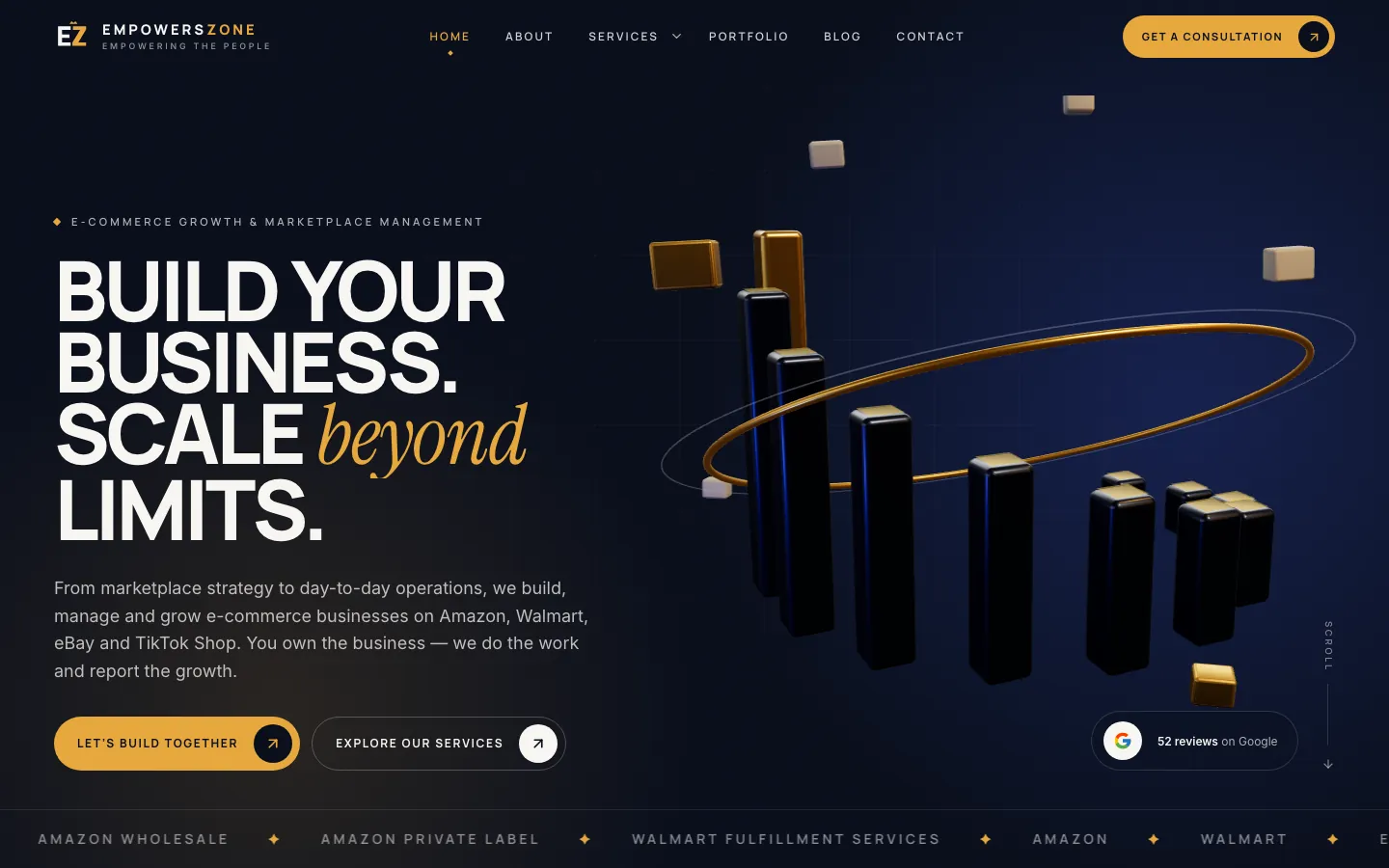 Enlarge screenshot: Agency homepage with 3D hero


Recent project
Empowers Zone
React website rebuild
Amazon service page. One of the prerendered service pages, written for one clear purpose: Amazon account management.
Read the case studyThe approach
Owning every layer changes the decisions. When the same person designs the screen and the query behind it, the API returns what the page needs, a slow page gets fixed at its actual cause, and deployment is planned from the start instead of being the last week's surprise. It also means one person is accountable when something breaks.
You work directly with me from requirements through launch. That keeps product context close to technical decisions and avoids the gaps that appear when strategy, interface, backend, and deployment are treated as separate problems.
What I can build
The scope is shaped around your users, operating reality, and the smallest responsible path to value.
Web apps for customers or staff, built from the login screen down to the database tables behind it.
Portals with a different view for each role, where the server checks permissions on every request instead of the interface just hiding buttons.
Subscription products with accounts, billing and the core feature in one codebase.
Platforms where an API is the backbone, serving a web front end, a mobile app or partner systems.
Layers
This is the work behind a typical full-stack project, layer by layer.
| Layer | What I do |
|---|---|
| Interface | React components from your design, responsive layouts, forms with validation, and loading, empty and error states |
| Rendering | Next.js server rendering or static prerendering where pages need to load fast and be indexed |
| API | Express routes with input validation, authentication, role checks and consistent error responses |
| Data | Schema, migrations, indexes for the queries the app runs, and test data for development |
| Background work | Scheduled jobs, email sending and webhook handling outside the request cycle |
| Deployment | Staging and production environments, environment variables, SSL and backups |
The stack
On the front end I use React, with Next.js when pages need to be indexed by search engines or rendered on the server. TypeScript runs through the codebase so the shape of the data agrees between browser and server. On the server I use Node.js with Express for APIs and background jobs. For data, PostgreSQL or MySQL when records relate to each other and need constraints, MongoDB when the data is naturally document-shaped.
This website is a small example: I built it with React, Vite and TypeScript, prerendered to static HTML for speed and search, with a small PHP API behind the free tools. PHP made sense there because it runs on the hosting the site already uses. Picking the simplest runtime that fits is part of the job.
Existing code
A lot of full-stack work is picking up someone else's code. I start with a short review: how it runs locally, how it's deployed, the database and its migrations, test coverage, outdated dependencies, and where secrets are kept. You get a written list of risks ranked by impact, and I fix or build in that order.
I don't rewrite by default. Rewrites stop feature work for months and bring old bugs back. Most codebases improve faster by fixing the worst module first while new features keep shipping.
Limits
I'm one developer, and that's a trade-off to weigh. It works well for products where one person can hold the whole system in their head, and it removes the hand-offs between front-end and back-end teams. If you need native iOS and Android apps, several features built in parallel against a hard date, or round-the-clock on-call cover, you need a team, and I'll tell you before quoting.
What the work should create
Pricing
How pricing works
Client feedback
Reviews from clients I have worked with remotely, quoted as they wrote them.
The process
You get a senior engineering partner—not a black box. The process stays direct, collaborative, and focused on outcomes.
Clarify the problem, users, constraints, and measure of success.
Shape the right product, technical plan, and delivery path.
Create in focused iterations with quality visible at every step.
Test, deploy, measure, and improve with confidence.
Common questions
Yes. React and Next.js on the front end, Node.js and Express on the back end, and a relational or document database chosen for the data. I deploy it as well.
Yes. I review the architecture and code, rank the technical and product risks, and improve it step by step rather than rewriting by default.
You work directly with the person writing the code, so decisions don't pass through an account manager. My pricing policy is about half of what agencies charge. An agency is the better choice if you need several developers working at once.
Small fixes and larger builds both get a fixed price in US dollars after I read the requirements.
Yes, where they protect something that matters: permission checks, billing logic, data imports and the API contract. We agree the level of testing in the scope so it's priced in.
Mostly clients in the US and UK, working remotely from Lahore, Pakistan. Email and form messages get a reply within 24 hours, and WhatsApp messages within an hour.
50% at the start and 50% on final delivery, after your review on staging. Launch is followed by 15 days of free support, then monthly maintenance or per-task work.
Start a conversation
Tell me what you’re building, where you are in the process, and what success looks like. I’ll get back to you with a clear next step within 24 hours.
ali@bealinawaz.com