B2B and vertical SaaS platforms
Products for a specific industry or job, where the value is a workflow that generic tools don't model well.
Engineering service / Ali Nawaz
I build SaaS products end to end: the sign-up and onboarding flow, workspaces and team roles, subscription billing, the core feature your customers pay for, the admin side you use to run the business, and the deployment. I'm a single developer, so the person planning how accounts are separated is the same one writing the billing webhooks.
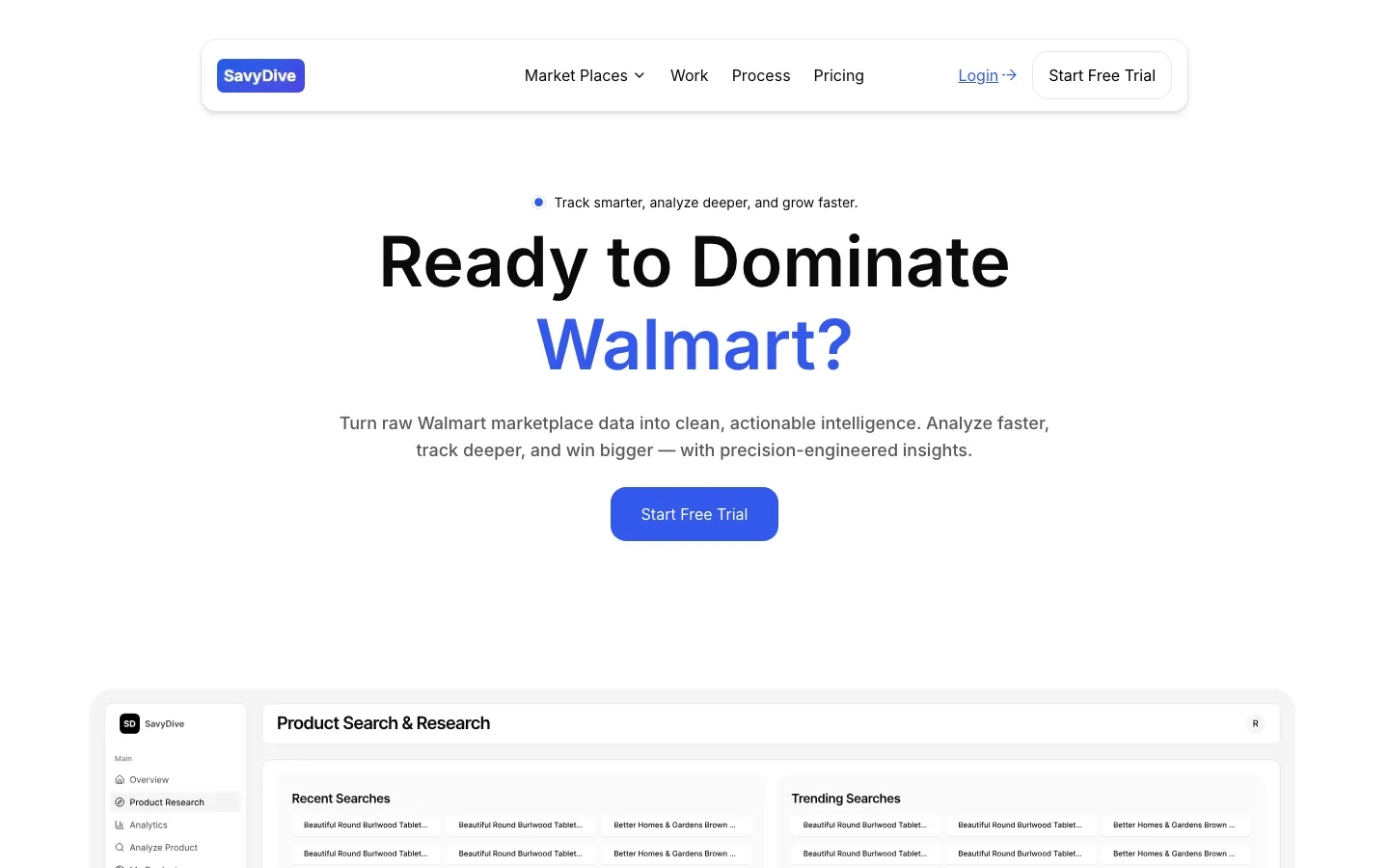 Enlarge screenshot: SavyDive homepage hero
Recent project
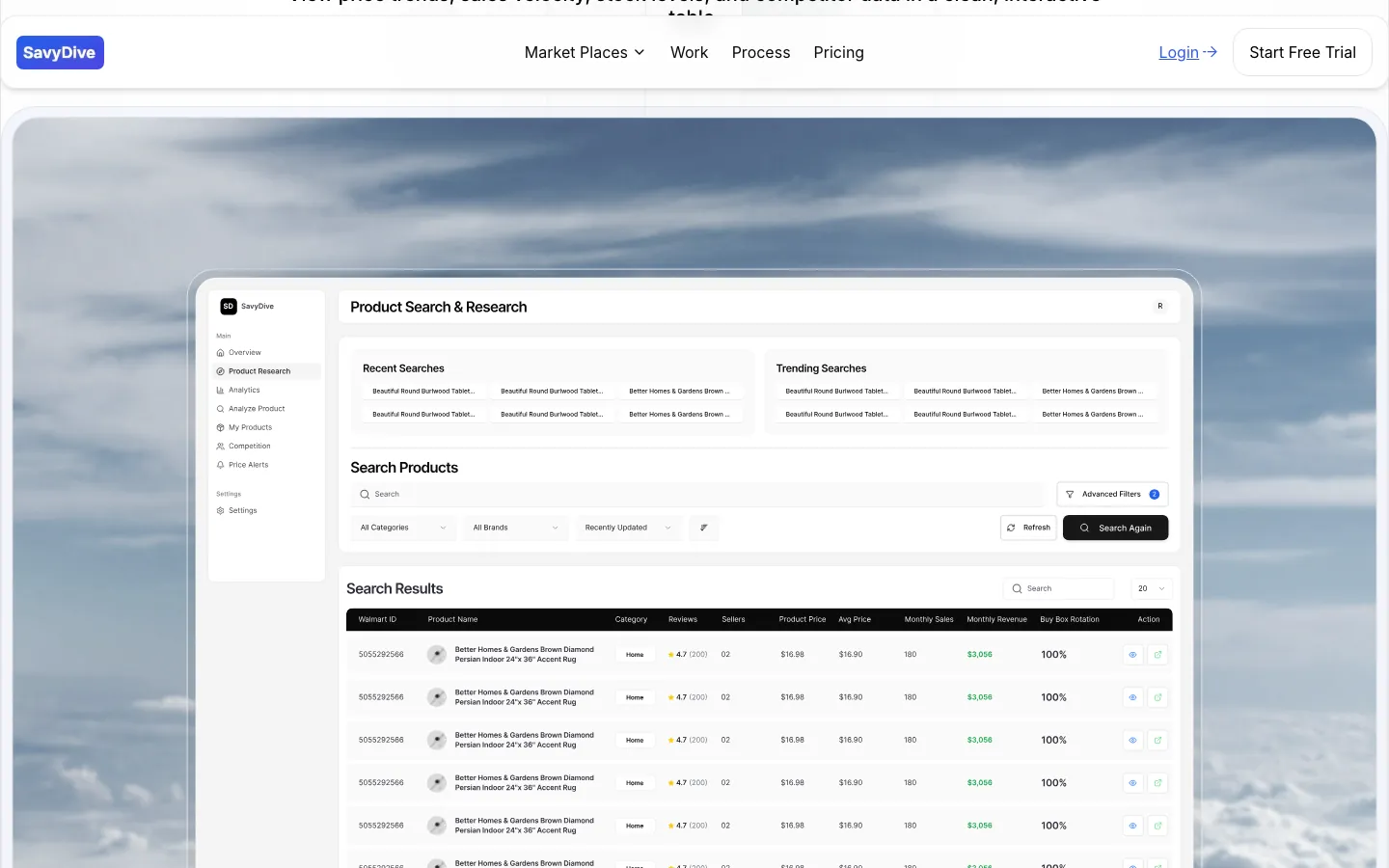
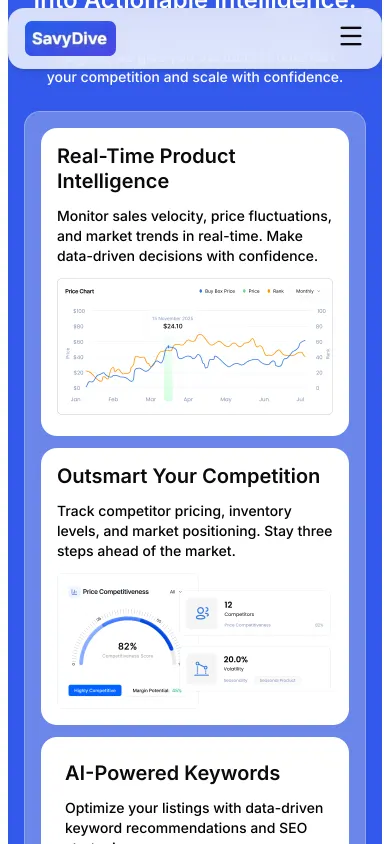
SavyDive
SaaS product
Product research dashboard. A data-rich research dashboard that lets sellers search, filter and compare Walmart products in one table.
Read the case studyThe approach
The first release of a SaaS has one job: get paying users onto the core workflow and show you what they do with it. I keep the domain logic separate from the billing, email and login providers so those can be swapped later, and I decide early how one customer's data is kept apart from another's, because that's expensive to change once real accounts exist.
You work directly with me from requirements through launch. That keeps product context close to technical decisions and avoids the gaps that appear when strategy, interface, backend, and deployment are treated as separate problems.
What I can build
The scope is shaped around your users, operating reality, and the smallest responsible path to value.
Products for a specific industry or job, where the value is a workflow that generic tools don't model well.
Plans, trials, upgrades, downgrades, failed payments and cancellations handled through the billing provider's webhooks, so access in the app always matches the subscription.
Workspaces with owners, admins and members, invitations by email, and permission checks on the server for every action.
Products built on data your customers can't easily gather themselves, sometimes with AI summaries or suggestions on top of it.
First release
Cutting scope is the fastest way to launch. This is how I usually split it, adjusted to your product.
| Area | What I put in the first release |
|---|---|
| Accounts | Email and password or Google sign-in, password reset and email verification |
| Workspaces | Owner and member roles with email invitations; custom roles come later |
| Billing | One or two plans, a trial, the provider's customer billing portal and webhook-driven access; usage-based pricing comes later |
| Core feature | The one workflow customers pay for, complete with empty, loading and error states |
| Admin | A screen to find a customer, see their plan and help them; full analytics come later |
| Transactional emails for sign-up, invites, receipts and failed payments | |
| Operations | Error logging, database backups and a staging copy for testing releases |
Tenancy
Every SaaS has to answer one question early: how is one customer's data kept away from another's? The common approaches are an account ID on every row with a check in every query, a separate schema per customer, or a separate database per customer. For most new products I use the first, because it's the cheapest to run and to update.
On PostgreSQL I can back that up with row-level security, a database feature that applies per-row policies to every query, so one missed check in application code doesn't leak data. Customers with contractual isolation needs can still be moved to their own database later.
Billing
Taking the first payment is the easy part. The work is everything after it: trials that end, cards that fail, plans that change mid-month, seats added and removed, refunds, and cancellations that should keep access until the period ends. I build the app to follow the billing provider's webhooks, so your database always knows each account's current state.
I usually recommend Stripe Billing, or Paddle when you'd rather have a merchant of record handle sales tax and VAT for you. The choice affects your fees and paperwork more than the code, so we settle it in the scope.
Proof
SavyDive is a live SaaS for Walmart sellers that I built: product and price intelligence, competitor tracking, forecasting, alerts and AI-powered keyword insights, sold on tiered plans. Just Big Dogs ESA is a guided multi-step customer application I built and put into production. Both have case studies linked from this page.
What the work should create
Pricing
How pricing works
Client feedback
Reviews from clients I have worked with remotely, quoted as they wrote them.
The process
You get a senior engineering partner—not a black box. The process stays direct, collaborative, and focused on outcomes.
Clarify the problem, users, constraints, and measure of success.
Shape the right product, technical plan, and delivery path.
Create in focused iterations with quality visible at every step.
Test, deploy, measure, and improve with confidence.
Common questions
Yes. I help you cut the idea down to a focused release, build it end to end, deploy it, and set up a staging copy so new features can be tested before your customers see them.
Authentication, teams and roles, subscriptions, dashboards, search, notifications, integrations with other tools, admin screens and AI features are the common ones. Which of them belong in version one is the main scoping decision.
A SaaS with billing and multiple roles costs significantly more than a simple app. I quote a fixed price in US dollars once I've read your requirements; my policy is to charge roughly half of what agencies do.
Multi-tenant, with all customers in one database and every row tagged by account, suits most new products. Single-tenant setups make sense when contracts require them, and the app can be designed so a large customer can move to their own database later.
Typically Next.js or React on the front end, Node.js on the server and PostgreSQL for the data, because relational constraints protect billing and permission rules. I'll use MySQL or MongoDB when the product fits them better.
You do. The repository, the hosting, the billing provider account and the domain are all in your name from the start.
You get 15 days of free support for fixes. Ongoing work runs as monthly maintenance or per task, which suits the way SaaS roadmaps change once real users arrive. The build itself is paid 50% upfront and 50% after you've approved it on staging.
Start a conversation
Tell me what you’re building, where you are in the process, and what success looks like. I’ll get back to you with a clear next step within 24 hours.
ali@bealinawaz.com