AI-assisted SaaS products
Subscription products where the AI feature is the core value, with accounts, plans and usage limits built in.
Engineering service / Ali Nawaz
I build AI applications from scratch: web products where an AI capability is the reason people sign up, with the interface, accounts, data, billing and deployment built around it. As one full-stack developer, I connect the model to everything else, so you launch a working product rather than a prompt behind a text box.
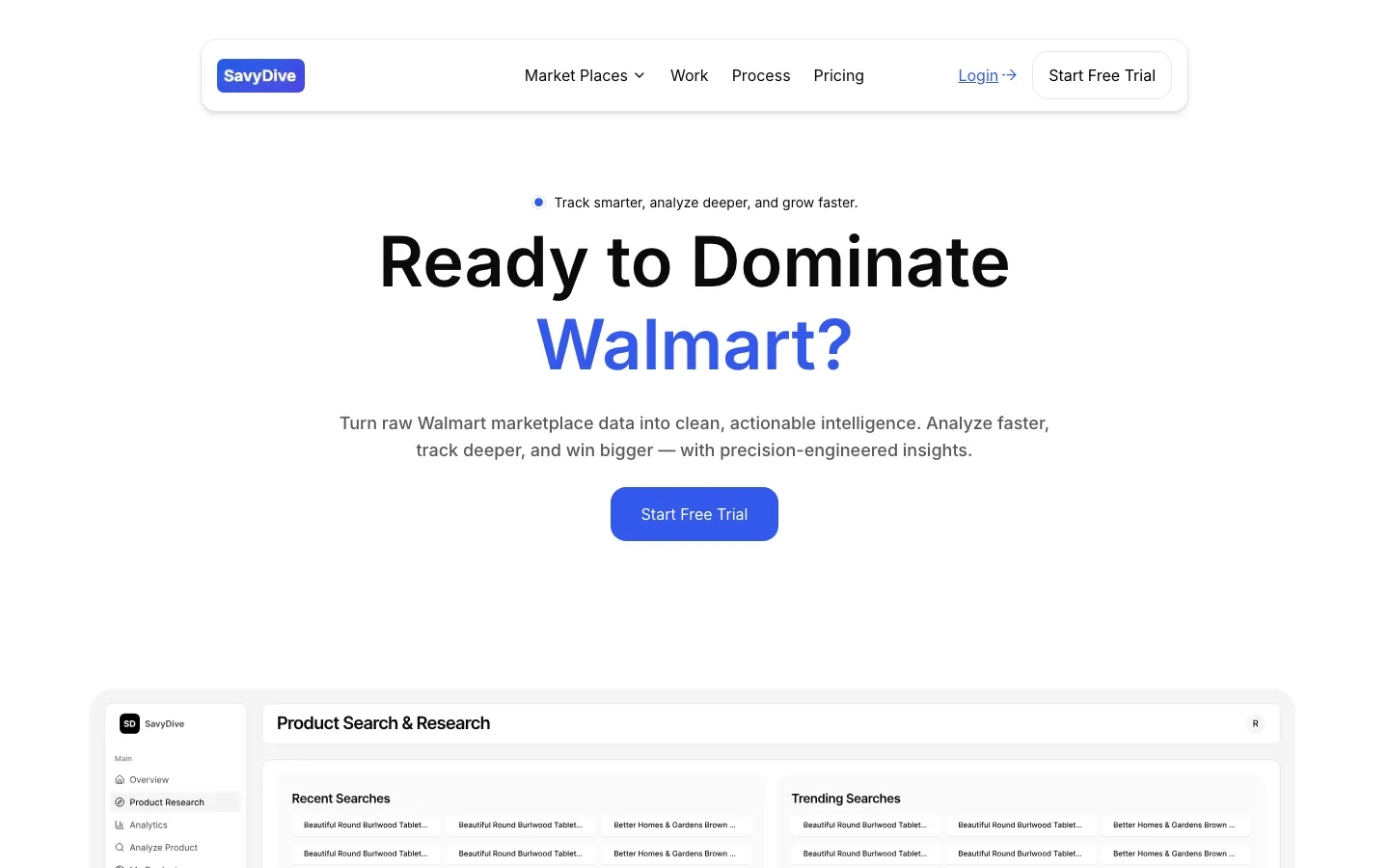 Enlarge screenshot: SavyDive homepage hero
Recent project
SavyDive
SaaS product
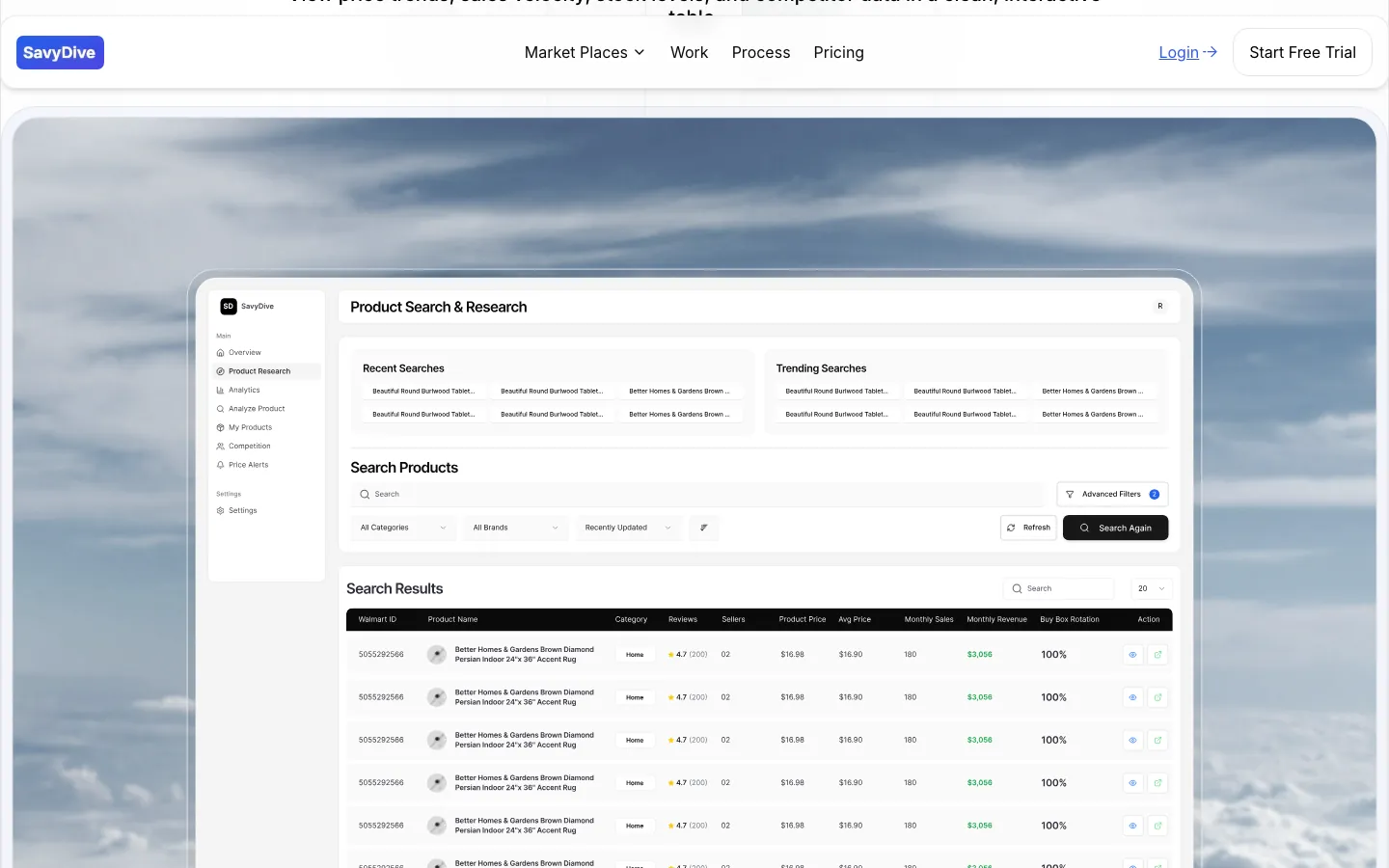
Product research dashboard. A data-rich research dashboard that lets sellers search, filter and compare Walmart products in one table.
Read the case studyThe approach
The model is the easiest part to swap and the hardest part to trust. A useful AI product also needs the right context at the right moment, responses your code can rely on, permissions, a way to recover from bad output, evaluation against real cases, cost controls, and an interface that tells users what the AI can and can't do.
You work directly with me from requirements through launch. That keeps product context close to technical decisions and avoids the gaps that appear when strategy, interface, backend, and deployment are treated as separate problems.
What I can build
The scope is shaped around your users, operating reality, and the smallest responsible path to value.
Subscription products where the AI feature is the core value, with accounts, plans and usage limits built in.
Apps that answer questions from a library of documents and cite the passages each answer came from.
Tools that turn messy input, such as notes, listings or data exports, into structured reports or content.
Search that understands meaning as well as keywords, and automations that take a step for the user once they approve it.
Build plan
Each stage ends with something you can review before the next one starts.
| Stage | What happens |
|---|---|
| Scope | The core AI task, the users, the data sources and what a good result looks like, written down with a fixed quote |
| Feasibility test | A prototype run against real examples to show the model can do the task well enough |
| Product build | Interface, accounts, data, retrieval, billing and the AI workflow built together |
| Guardrails | Output validation, usage limits, abuse protection, and fallbacks for when the model fails or times out |
| Staging review | You test the whole product with real cases before the final payment |
| Launch | Production deployment, logging of AI calls and costs, and 15 days of free support |
Architecture
A typical AI application has a web front end, a server that holds the API keys and the business rules, a database of users and their data, and often a retrieval layer that finds the right documents for each request. The model call sits in the middle of that. Responses can stream to the screen, so users see progress instead of a spinner.
I keep the model provider behind one layer in the code. Models change quickly, and you should be able to move to a better or cheaper one without rebuilding the app.
Evaluation
I build an evaluation set early: real inputs with the answers or qualities a good result should have. Every change to prompts, retrieval or the model runs against it, so improvements are measured, not guessed. After launch, outputs users flag as wrong are added to the set.
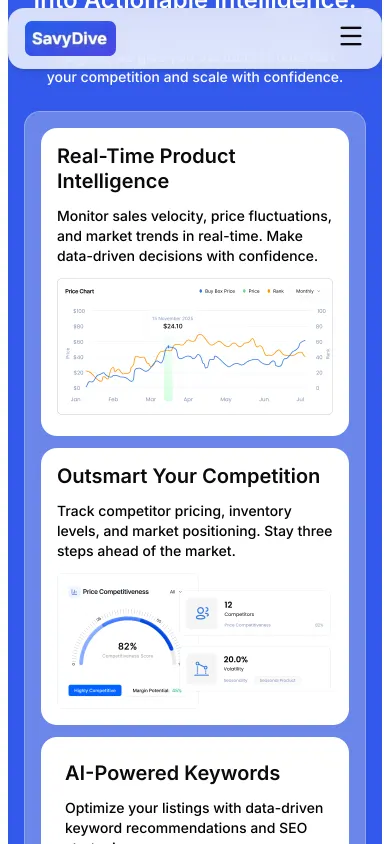
SavyDive, a SaaS for Walmart sellers that I built, includes AI-powered keyword insights alongside its data dashboards. In a product like that, the AI is only as useful as the data underneath it.
Running costs
An AI product has a running cost that grows with use: model calls, plus hosting, a database and sometimes a vector store. I estimate it per active user before building, so you can set prices and plan limits that cover it. Model usage is billed to your own provider account.
Also plan for tuning after launch. Real users ask things the test set didn't cover, and the first weeks show where retrieval or instructions need work.
What the work should create
Pricing
How pricing works
Client feedback
Reviews from clients I have worked with remotely, quoted as they wrote them.
The process
You get a senior engineering partner—not a black box. The process stays direct, collaborative, and focused on outcomes.
Clarify the problem, users, constraints, and measure of success.
Shape the right product, technical plan, and delivery path.
Create in focused iterations with quality visible at every step.
Test, deploy, measure, and improve with confidence.
Common questions
Everything around the AI as well as the AI layer itself: the interface, APIs, database, integrations, authentication, deployment, and the controls that keep cost and output quality in check.
Yes. If you already have a product, my AI Integration service covers adding a feature to it. This service is for new products where AI is the core.
Usually there's no need. Most products work best with a hosted model, good retrieval from your own data and careful instructions. Fine-tuning comes up only after those have been tried and measured.
A full AI product with accounts and billing costs considerably more than a single feature. I read your requirements and quote a fixed price in US dollars; model usage is a separate running cost billed by the provider.
By grounding answers in your own documents, asking the model for structured output with citations, validating results in code, and telling users when no answer was found instead of letting the model guess.
You do. The code, the hosting, the database and the model provider account are all in your name.
50% when the project starts and 50% on final delivery, once you've reviewed the product on staging. My pricing policy is roughly half of what agencies charge.
Start a conversation
Tell me what you’re building, where you are in the process, and what success looks like. I’ll get back to you with a clear next step within 24 hours.
ali@bealinawaz.com