Content and catalog systems
Pages, blocks and catalog items whose fields differ from one record to the next, stored and read as single documents.
Technology expertise / Ali Nawaz
I use MongoDB with Node.js when the data is naturally made of documents: records that are read and written whole, vary in shape, and rarely need joining with others. Think activity logs, content blocks, product catalogs with very different attributes, or app settings. When the data is full of relationships, I usually recommend a relational database instead, and I'll say so.
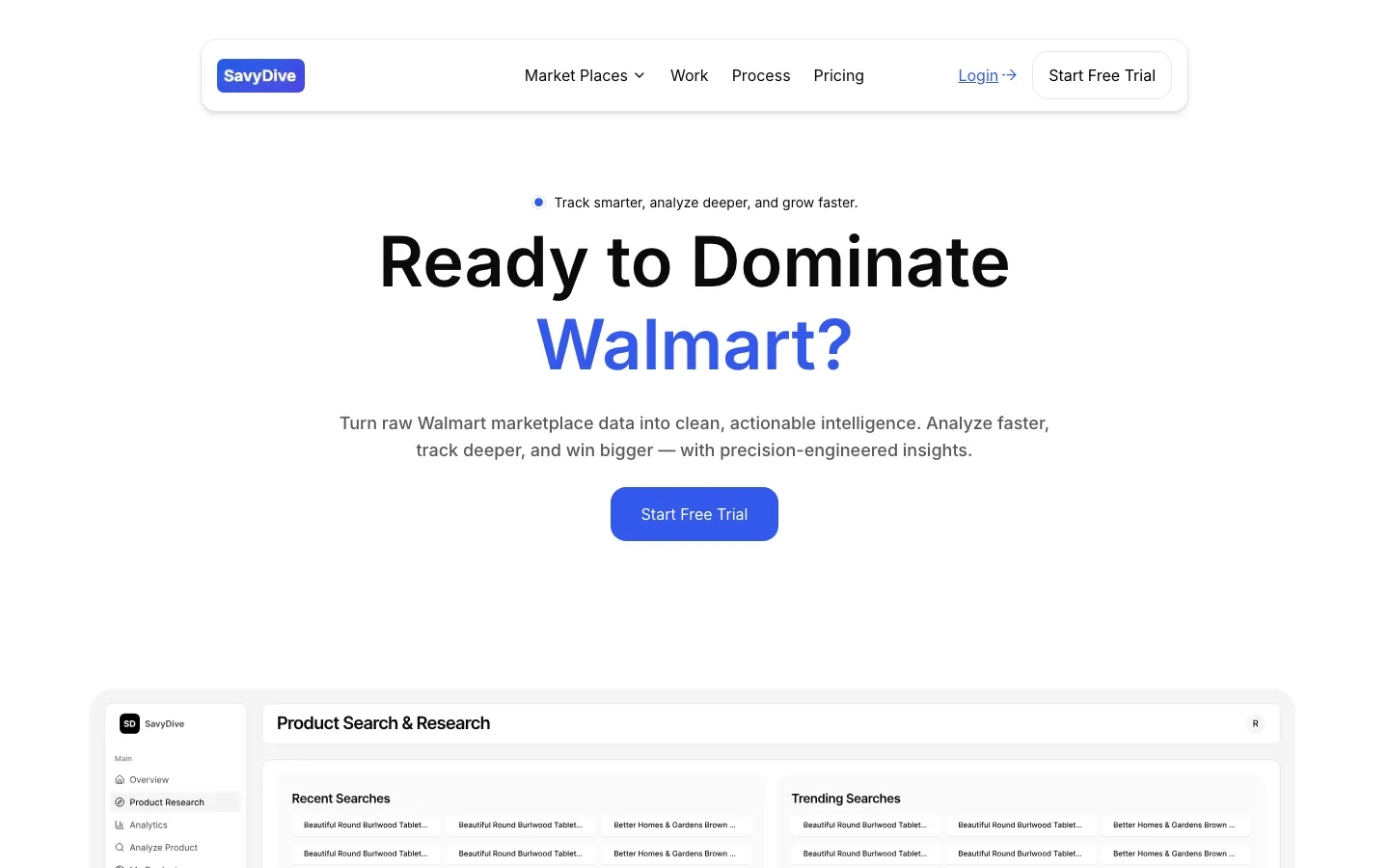 Enlarge screenshot: SavyDive homepage hero
Recent project
SavyDive
SaaS product
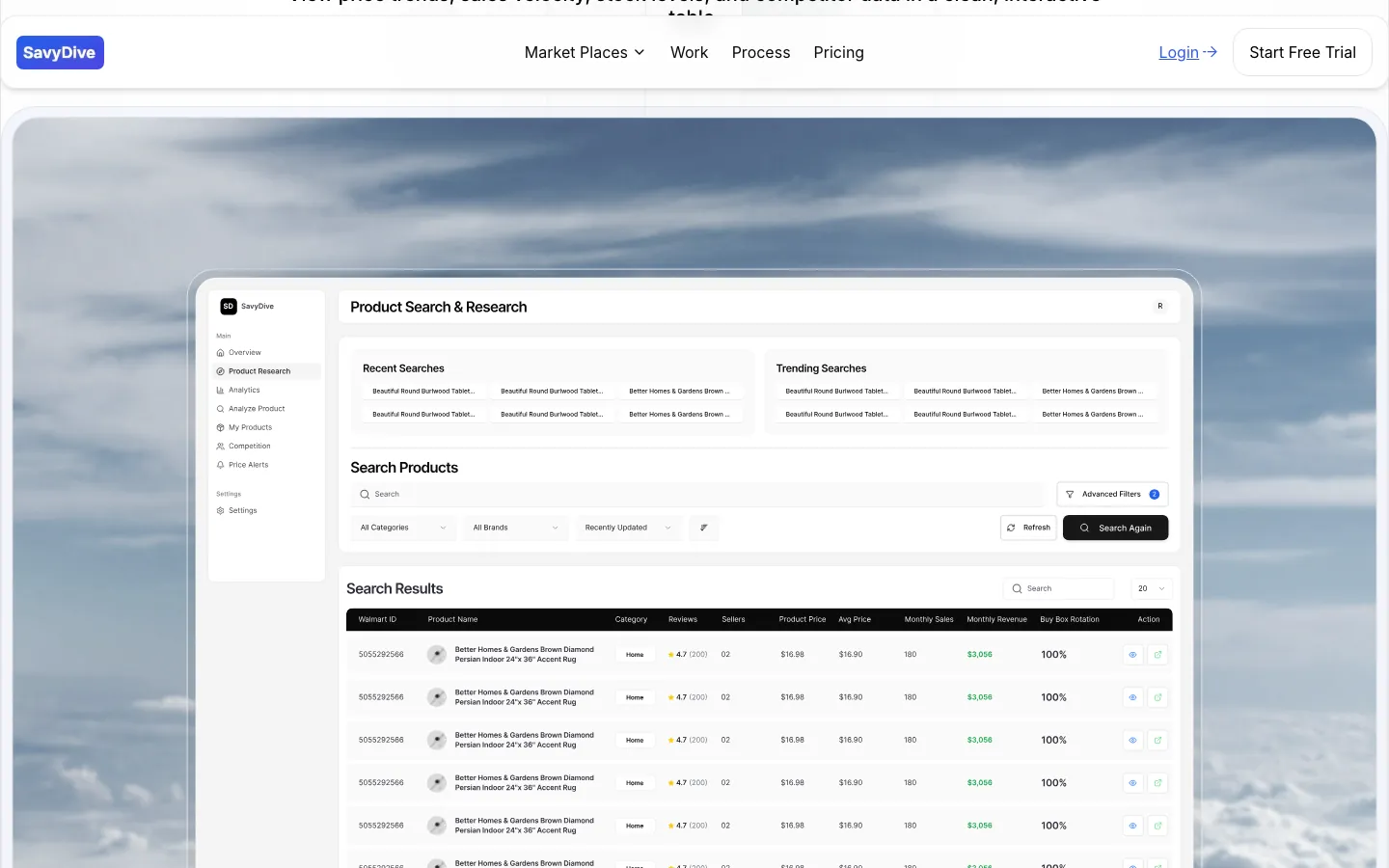
Product research dashboard. A data-rich research dashboard that lets sellers search, filter and compare Walmart products in one table.
Read the case studyThe approach
Schemaless doesn't mean modeling is optional. In MongoDB the design work moves from tables to documents: what goes inside one document, what gets its own collection, and which queries must be fast. Get that right and reads are simple. Get it wrong and you end up with copied data that drifts out of sync. I decide those boundaries first and back them with schema validation.
You work directly with me from requirements through launch. That keeps product context close to technical decisions and avoids the gaps that appear when strategy, interface, backend, and deployment are treated as separate problems.
What I can build
The scope is shaped around your users, operating reality, and the smallest responsible path to value.
Pages, blocks and catalog items whose fields differ from one record to the next, stored and read as single documents.
Logs, events and audit trails that are written often, read in time order, and rarely updated.
APIs where MongoDB documents map directly to the JSON the front end receives, with validation on both ends.
Early-stage products whose data shape changes weekly, with versioned documents so changes don't break older records.
Modeling choices
These are typical calls I make when designing collections, and the reasoning behind each.
| Data | How I model it |
|---|---|
| Order line items | Embedded in the order, with product name and price copied at purchase time, since history shouldn't change |
| Customers | Their own collection, referenced by ID from orders, because they change independently |
| Comments or activity | A separate collection keyed by parent ID, since the list can grow without limit |
| Products with varied attributes | One collection with a shared core and a flexible attributes object, validated per product type |
| Counts and totals | Updated in the same write as the change, or computed by aggregation when freshness matters less |
| Schema changes | A version field and a migration script, so old and new documents are both handled correctly |
Document thinking
My WP to Firebase plugin copies WooCommerce products, orders and users from MySQL into Cloud Firestore, as typed documents in collections, or into a Firebase Realtime Database, which stores data as a JSON tree, where a mobile app or dashboard reads it. Building it meant turning related tables into documents shaped for how the app reads them, deciding what to copy and what to reference, and keeping the copies in step through background batches and live updates.
Firebase isn't MongoDB, but the judgement is the same: design documents around the reads, accept some duplication, and have a clear process that keeps duplicated data correct.
Pitfalls
Arrays that grow forever inside one document until writes slow down. Relational data forced into documents, then joined with $lookup on every request. No validation, so the same field is a string in one document and a number in another. Indexes on every field, which slow writes, or none at all, which scans whole collections. Queries built from raw user input, allowing operator injection. And databases exposed to the internet without authentication.
Choosing honestly
Many business apps are made of customers, orders, invoices and permissions: connected data with strict rules. A relational database handles that with less code and fewer surprises. I choose MongoDB when the documents are the natural unit, not because it seems faster to start. If you already run MongoDB and it fits poorly, I can help reshape the collections or plan a move to PostgreSQL.
What the work should create
Pricing
How pricing works
Client feedback
Reviews from clients I have worked with remotely, quoted as they wrote them.
The process
You get a senior engineering partner—not a black box. The process stays direct, collaborative, and focused on outcomes.
Clarify the problem, users, constraints, and measure of success.
Shape the right product, technical plan, and delivery path.
Create in focused iterations with quality visible at every step.
Test, deploy, measure, and improve with confidence.
Common questions
When records are read as a whole, their shape varies and joins are rare. For orders, invoices, users with roles and other connected data, PostgreSQL or MySQL is usually the safer choice.
Yes, multi-document transactions are supported on replica sets and sharded clusters. If an app needs them on most writes, though, that's often a sign the data is relational and a SQL database would fit better.
I add JSON Schema validation to each collection, so MongoDB rejects documents with missing or wrongly typed fields, and I keep a version field on documents whose shape changes over time.
Embed data that's always read with its parent and stays small, such as an order's line items. Reference data that's shared, grows without limit or changes on its own, such as a customer. MongoDB documents also have a 16 MB size limit, so unbounded arrays don't belong inside them.
From the actual queries. For compound indexes I follow MongoDB's equality, sort, range order, and I check query plans with explain() before and after.
Yes. I map each collection to tables, decide which embedded data becomes its own table and which stays as JSONB, write a repeatable migration script, and run it on a copy first. The app is switched over only after record counts and sample records match.
My database development service page covers scope and pricing for MongoDB, MySQL and PostgreSQL work.
Start a conversation
Tell me what you’re building, where you are in the process, and what success looks like. I’ll get back to you with a clear next step within 24 hours.
ali@bealinawaz.com