Frontend and Node.js deployments
Static and server-rendered front ends deployed to a static host, Vercel or your own server, and Node.js APIs run as managed processes.
Engineering service / Ali Nawaz
I take web applications from a working build to a live, maintained service: React and Next.js front ends, Node.js APIs, PHP apps and the databases behind them. I set up environments, secrets, domains, SSL, the database, a repeatable release process and backups, on hosting that fits the app, whether that's a static host, a platform like Vercel, a VPS or a cloud provider.
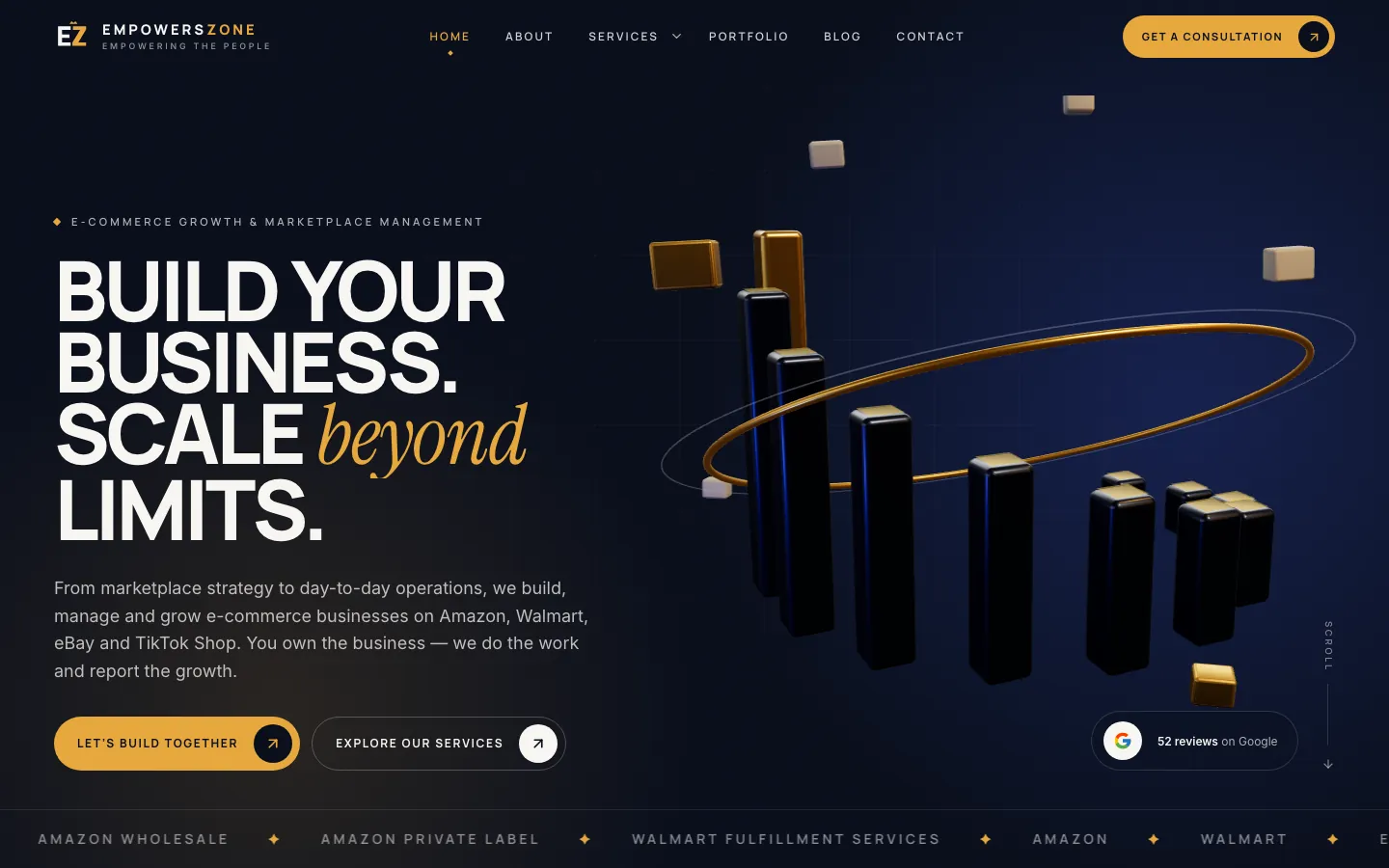 Enlarge screenshot: Agency homepage with 3D hero


Recent project
Empowers Zone
React website rebuild
Amazon service page. One of the prerendered service pages, written for one clear purpose: Amazon account management.
Read the case studyThe approach
A deployment is finished when someone other than the original developer can ship an update safely. That means a build that reproduces from the repository, staging that matches production, secrets kept out of the code, database changes run as migrations, a way to roll back, and logs you can read when something goes wrong.
You work directly with me from requirements through launch. That keeps product context close to technical decisions and avoids the gaps that appear when strategy, interface, backend, and deployment are treated as separate problems.
What I can build
The scope is shaped around your users, operating reality, and the smallest responsible path to value.
Static and server-rendered front ends deployed to a static host, Vercel or your own server, and Node.js APIs run as managed processes.
The production database created, migrations applied in order, and a backup taken before any change to live data.
Domains pointed, SSL issued and renewed automatically, redirects from old URLs, and a reverse proxy where the app needs one.
Separate settings for development, staging and production, with secrets stored in the host's environment settings instead of the repository.
Checklist
Every production deployment goes through these checks before real users arrive.
| Check | Why it matters |
|---|---|
| Build runs from a clean clone | Proves nothing depends on files that only exist on one machine |
| Secrets in environment settings | Keeps passwords and API keys out of the repository and its history |
| Migrations tested on staging | Catches schema changes that would fail or lose data on the live database |
| Backups taken and restored once | A backup that has never been restored is a hope, not a backup |
| Error logging switched on | The first report of a problem comes from the logs, not an annoyed user |
| SSL renewal tested | Certificates that expire quietly take the site down without warning |
| Rollback rehearsed | The previous version can come back quickly if a release fails |
| Redirects from old URLs | Links and search rankings survive when the app replaces an old site |
Choosing hosting
The right host depends on what the app does. A site that can be prerendered to static files, like this one, can sit on simple hosting or a CDN and costs very little to run. A Next.js app that renders on the server fits a platform built for it, or a Node.js server. An API with background jobs and a database often belongs on a VPS or a cloud service.
I compare two or three options on monthly cost, the maintenance they need, and how hard they'd be to leave. My VPS Deployment and Cloud Deployment pages cover those two routes in detail.
Releases
Releases should come from the repository, not from someone's laptop. On each push, a pipeline installs dependencies, runs the build and tests, and deploys to staging. Production gets the same build after you approve it. If a release goes wrong, the previous version can be restored quickly, and migrations are written to be reversible or safe to run twice.
Rescue
Often the app works, but nobody knows how it was deployed. The original developer has moved on, the server hasn't been updated in years, or releases happen by copying files over FTP. I start by mapping what's there: the runtime, the processes, the database, the cron jobs, the DNS and the certificates. Then I write it down and move it to a repeatable setup without downtime.
Two of my free tools help around a move: the Hosting Checker shows who hosts a site and which CDN sits in front, and the Bulk Redirect Checker tests old URLs after the switch.
What the work should create
Pricing
How pricing works
Client feedback
Reviews from clients I have worked with remotely, quoted as they wrote them.
The process
You get a senior engineering partner—not a black box. The process stays direct, collaborative, and focused on outcomes.
Clarify the problem, users, constraints, and measure of success.
Shape the right product, technical plan, and delivery path.
Create in focused iterations with quality visible at every step.
Test, deploy, measure, and improve with confidence.
Common questions
Yes. I first review its build, runtime, database, environment variables and dependencies, then plan a safe path to production.
Yes. After the 15 days of free support that follow launch, I can handle updates, backups, release help and incident fixes as monthly maintenance or per task.
It depends on how the app renders, whether it runs background jobs, how much traffic it gets and who will maintain it. I compare a few options with their monthly costs and recommend one.
Yes. I set up pipelines, usually in GitHub Actions, that build, test and deploy on each push to the right branch, with production deploys waiting for approval.
The cost depends on how many services and environments you run, the database and backups, and whether you want automatic deployments; fixing one broken deployment is far smaller than a full production setup. Hosting is paid directly to the provider, so it never runs through my invoice.
I test the new setup fully before DNS is switched, and lower DNS cache times beforehand so the change takes effect quickly. Apps with a live database usually need a short pause on writes while the final data copy runs.
Half before I start and half on final delivery, once you've checked the deployment works. Invoices are in US dollars.
Start a conversation
Tell me what you’re building, where you are in the process, and what success looks like. I’ll get back to you with a clear next step within 24 hours.
ali@bealinawaz.com