Application APIs
JSON APIs for React and mobile front ends, where one language across the stack lets types and validation rules be shared.
Technology expertise / Ali Nawaz
I use Node.js for application backends and for the tooling around them. This site's build runs on Node: scripts generate the sitemap, render every route to static HTML, check the content and stamp last-modified dates, and its tests run on Node's built-in test runner. I write Node code in TypeScript and modern ES modules.
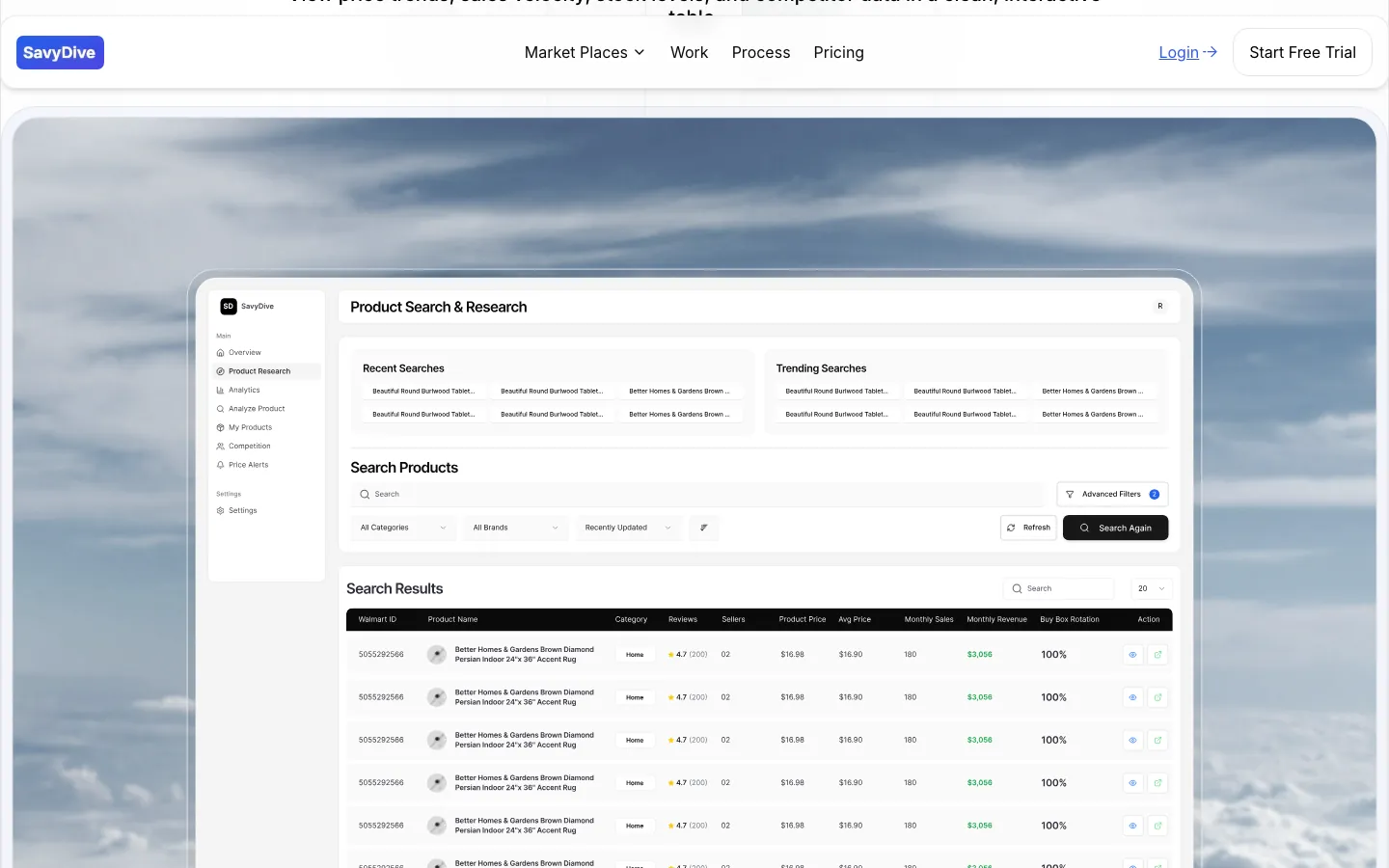
 Enlarge screenshot: SavyDive homepage hero
Recent project
SavyDive
SaaS product
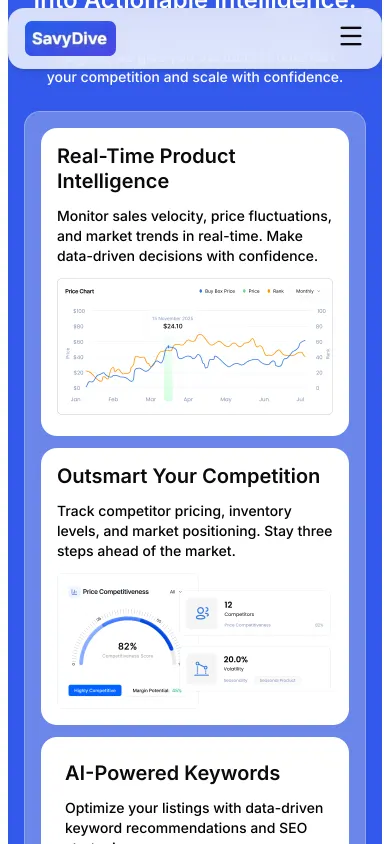
Product research dashboard. A data-rich research dashboard that lets sellers search, filter and compare Walmart products in one table.
Read the case studyThe approach
Node is excellent at waiting: for the database, for an API, for a file. It's poor at heavy computing on the main thread, because one slow loop stalls every request. Most Node problems I'm asked about trace back to that, or to errors that were caught and silently ignored. I design services around those two facts from the first file.
You work directly with me from requirements through launch. That keeps product context close to technical decisions and avoids the gaps that appear when strategy, interface, backend, and deployment are treated as separate problems.
What I can build
The scope is shaped around your users, operating reality, and the smallest responsible path to value.
JSON APIs for React and mobile front ends, where one language across the stack lets types and validation rules be shared.
Small services that sit between platforms, translating and forwarding data when an order, form or payment event arrives.
Queues and scheduled jobs for work that's slow or must retry, kept separate from the web process that serves users.
Sessions, tokens, password hashing and role checks written carefully, since this is where shortcuts cause real damage.
Habits
These are the rules I follow in every Node service, whatever framework sits on top.
| Concern | What I do |
|---|---|
| Errors | No empty catch blocks; errors are logged with context and returned in one consistent shape |
| Input | Every request body, query and webhook payload validated against a schema before use |
| Blocking work | CPU-heavy tasks moved off the main thread or out of the request, so one user can't slow everyone |
| Secrets | Loaded from environment settings, never committed, and never sent to client code |
| Dependencies | Few, maintained and audited, with a lockfile, so installs are repeatable and the attack surface stays small |
| Shutdown | Graceful handling of stop signals so deploys finish in-flight requests instead of dropping them |
Node as tooling
The site you're on is built by a chain of Node scripts. One generates the sitemap from the same data that defines the pages. Another loads the server-rendered React bundle and writes static HTML for every route, inlining the stylesheet so the first paint needs no extra request. A content check then reads every generated page and reports any that fall short of the site's content rules. It's all plain Node with no framework, run on every deploy.
That kind of work, where Node glues steps together and makes a build repeatable, is as much a part of my Node experience as API servers.
Pitfalls
Promises started without await, so errors vanish and requests finish before the work does. Synchronous file or crypto calls inside request handlers. Database connections opened per request instead of pooled. Webhooks processed without checking the signature or whether the same event already arrived. Logs that print whole request bodies, including passwords and tokens. And a package.json with dozens of dependencies for things Node now does natively, such as fetch, a test runner and file watching.
Each fix is small, and together they're usually the difference between a service that needs restarting and one that runs quietly.
Choosing a runtime
The site's hosting serves PHP out of the box, and the tools' server-side checks, including the Bulk Redirect Checker, are short request-response scripts. A Node service would have needed its own process, monitoring and restarts for no gain. I chose PHP there, and I'd make the same kind of call on your project: the runtime that fits the hosting and the job, not the one I like most.
What the work should create
Pricing
How pricing works
Client feedback
Reviews from clients I have worked with remotely, quoted as they wrote them.
The process
You get a senior engineering partner—not a black box. The process stays direct, collaborative, and focused on outcomes.
Clarify the problem, users, constraints, and measure of success.
Shape the right product, technical plan, and delivery path.
Create in focused iterations with quality visible at every step.
Test, deploy, measure, and improve with confidence.
Common questions
Current LTS lines for production; in November 2026 that's 22, 24 and 26. Node 20 is now end of life, so apps still on it are a priority to upgrade. From Node 27, the project moves to one major release a year.
When the hosting already runs PHP and the job is small, as with the free tools on this site, whose server checks run on a short PHP API. Also for CPU-heavy work like video processing, where a worker thread, a separate service or another language fits better.
Yes, for anything beyond a small script. Shared types between the API and the front end catch mismatches at build time instead of in production.
Express for most APIs, and Next.js route handlers when the backend lives alongside a Next.js front end. I'm comfortable with lighter or more structured options too, but I prefer fewer layers when the project doesn't need them.
Anything slow or retryable, such as emails, imports or webhook processing, goes to a queue or scheduled job rather than running inside the request. Each job is safe to run twice.
Yes. I check the Node version, dependencies with known vulnerabilities, error handling and logging first, because those decide how risky the next change is.
My Node.js development service page explains scope, deliverables and pricing for a backend project.
Start a conversation
Tell me what you’re building, where you are in the process, and what success looks like. I’ll get back to you with a clear next step within 24 hours.
ali@bealinawaz.com